
If you’d like to talk about any of the topics listed here or share your own ideas, feel free to write to me.
On this page, you can find informative, educational, or inspiring content for your business
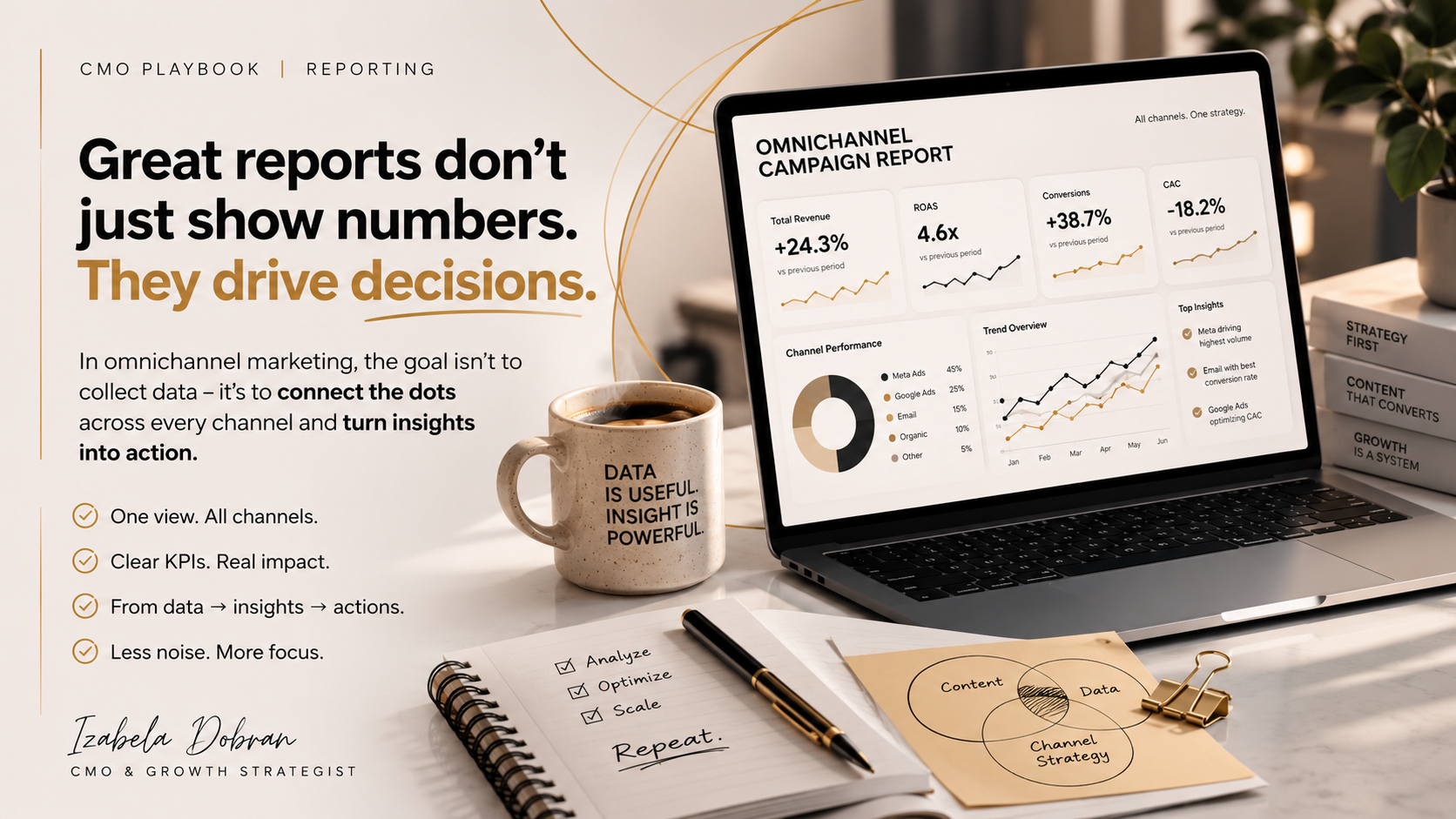
Photo credit by: ChatGPT
MARKETING & BRANDING
Omnichannel reporting is about making better decisions.
Omnichannel reporting isn't about collecting data. It's about transforming numbers into strategic decisions. A strong reporting framework connects customer journeys, channels and business goals.
One of the biggest mistakes I see in performance marketing
is reporting each channel separately.
Meta has one report. Google Ads has another.
Email has its own dashboard. CRM tells a different story.
The result? Lots of numbers. Very little clarity.
An effective omnichannel report should answer three questions:
• Are we achieving business goals?
• Which channels create real incremental value?
• What should we do next?
A report should never be a collection of KPIs.
It should tell the story behind customer behavior
across every touchpoint and translate data into action.
Data informs. Insights transform. Action drives growth.

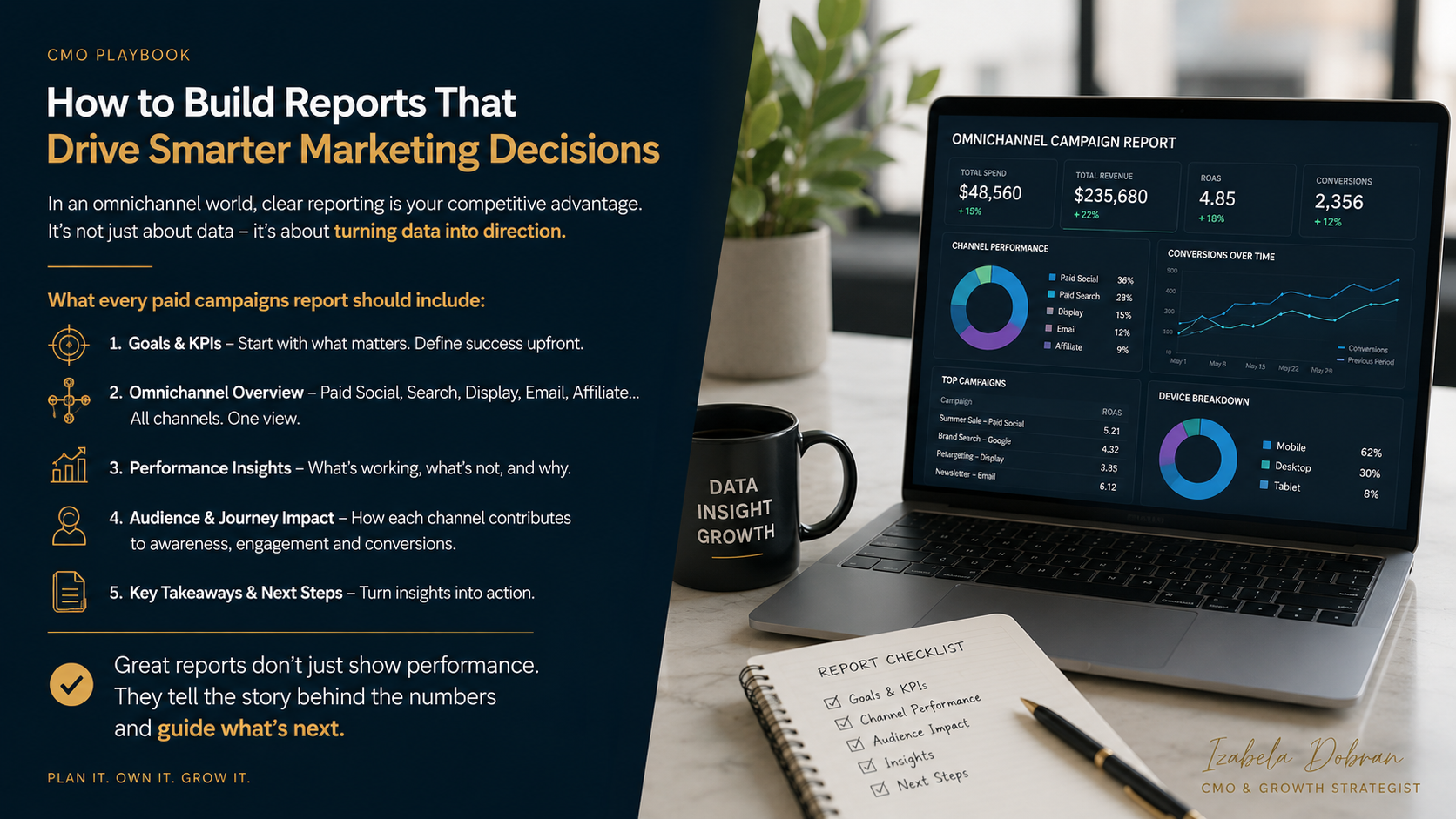
Photo credit by: ChatGPT
MARKETING & BRANDING
Marketing reporting connects the entire customer journey.
A great marketing report doesn't impress stakeholders with numbers.
It gives them confidence to make better decisions.
Every week, marketing teams generate dozens of dashboards.
But executives rarely ask for more charts — they ask:
"What does this mean for the business?"
That's the real purpose of omnichannel reporting.
Instead of measuring each platform independently, connect the entire customer journey.
A high-impact report should include:
→ Business KPIs before channel KPIs.
→ Performance by funnel stage.
→ Cross-channel attribution.
→ Cost efficiency and incremental growth.
→ Key learnings.
→ Recommended next actions.
Good reporting explains what happened.
Great reporting explains why it happened and what should happen next.
When reporting becomes a strategic tool — not an operational task — marketing earns a seat at the leadership table.
Because decisions don't come from dashboards.
They come from clarity.
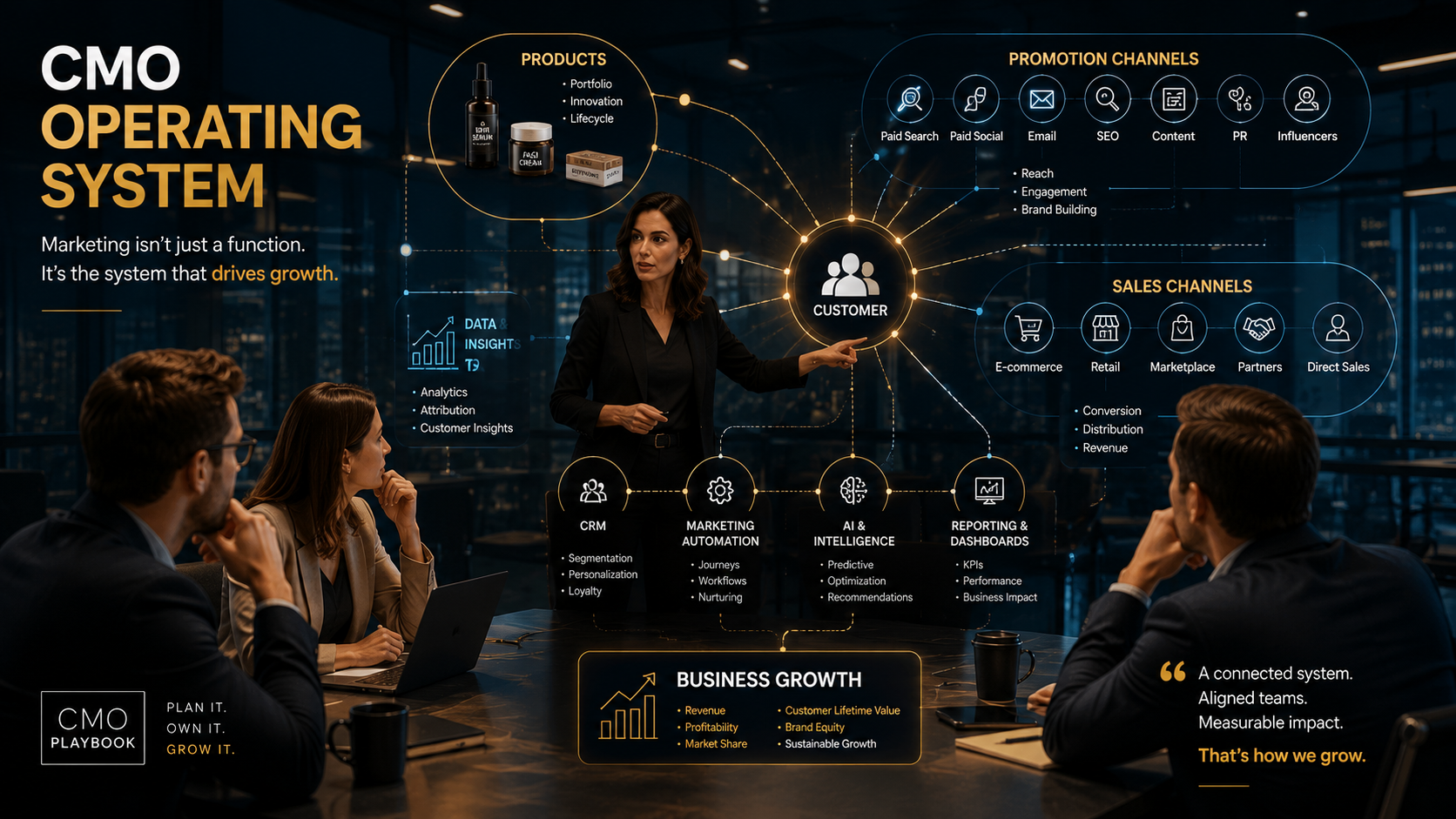
Photo credit by: ChatGPT
MARKETING & BRANDING
Marketing operating system problems
Most companies don't have a marketing problem.
They have a marketing operating system problem.
Marketing isn't a collection of campaigns, channels, or dashboards.
It's a connected system where strategy, people, technology, data, and execution must work together toward the same business objective.
When these elements operate in silos, even the best campaigns struggle to create sustainable growth.
High-performing marketing organizations ask different questions:
• Are our products aligned with customer needs?
• Do our sales and marketing channels reinforce each other?
• Is our data helping us make faster, better decisions?
• Can every team explain how their work contributes to business growth?
The role of a modern CMO is no longer only to manage marketing.
It's to design and orchestrate a system that enables predictable growth.
Because growth isn't the result of one successful campaign.
It's the outcome of a well-designed operating system.
What's the biggest challenge in building a connected marketing organization?

Photo credit by: Freepik
MARKETING & BRANDING
How to start marketing and branding your business? In parallel!
1. Question: Defining the Company.
How should the answer look? Let’s take a beauty salon as an example.
Possible answers: "Hair & Beauty Salon", "Beauty Studio", or "Wellness & Style Studio".
2. Question: Company Name.
Examples: "Gaga", "Gaga Style", "Dragana Lazić Studio", or "Fancy Style".
3. Question: Defining the Service or Product.
Example answers: "Hair, face, and body care", "Hairdressing and beauty services", or "Hair salon and facial/body treatments".
What do you notice here? The key difference lies in how the definition is formed.
Marketing defines the Who? What? Where?, while branding defines the How?
The choice of name sets the tone of communication with the client — and that tone is essential for branding.
4. Question: What kind of service is it?
For example: High-quality service — using quality products, professional equipment, and skilled staff in a pleasant environment.
That’s the marketing approach.
Now branding adds some flavor: Exceptional service, Top-tier experience, Outstanding treatments.
That’s what makes your brand recognizable and different from others.
foto credit by: Freepik

BRANDING
Branding, emotions, and customer attitudes toward us – what tone should we use?
It’s always the same, tricky question — what tone should we use when talking to a client?
How do we elevate the client without lowering ourselves?
Let’s start with this: what kind of feeling does every client enjoy?
Comfort, care, attentiveness, empathy, safety, the sense of doing something good for themselves —
all these lead to one clear emotion: trust.
So, the tone of our communication should guide the client toward that feeling of trust.
How? Through the atmosphere we create in our space, the time we dedicate to the client
(ideally — without rushing, but also without dragging it out), the professionalism of our team,
attention to hygiene, and care for the client’s safety.
And how does this look in practice? For example:
– Branded cup or glass lids to keep things clean during treatments.
– A simple tissue box for clients to use — looks elegant, costs little, but shows respect.
– A small stool or shelf near the client’s seat for their bag — practical and thoughtful.
– Hangers for coats and jackets — no need to throw them over a chair!
These small details play a big role in branding.
The clearer and more specific your marketing and branding strategies are,
the easier your advertising will be. And most importantly — no false promises!
What’s promised through branding, defined by marketing, and communicated through advertising
must exist in reality.
When that alignment happens — success is guaranteed.
Photo credit by: Freepik

BRANDING VS ADVERTISING
Branding the space / environment / atmosphere? – No, it’s about emotion
The place where business happens is one of the 4Ps (Product, Place, Price, Promotion) — the core of marketing defined back in 1960 by E. Jerome McCarthy.
Therefore, branding your space is a crucial part of your business. The more pleasant the environment is for clients,
the more often they’ll visit. That’s the foundation of the entire service industry — so play that card too.
How can I help? Let’s start with the basics: color choice. Color = Emotion = Brand.
Each color evokes a certain feeling:
Beige – comfort, refinement, balance
White – cleanliness, order
Light green – nature, relaxation
Lavender – spirituality, calmness
Blue – transparency, intelligence
Surgical green – innovation, modernity
Black – elegance, precision
Brown – evokes coffee and chocolate (pleasant in small amounts)
Navy blue – sophistication
Baby pink – tenderness, elegance
Orange – call to action, awakening
Red – boldness
Yellow – joy, cheerfulness, childlike energy
Pink – youthful, playful
Purple / Violet – luxury, abundance
Play with colors! Ideally, your posts and ads should reflect the tones of the environment where you welcome clients.
The key word again: Trust. When clients see consistency — what they saw in your ads matches what they experience in your space — they relax.
A relaxed tone builds trust, relationships, your brand, and of course, your profit.
Besides colors, the atmosphere also includes materials like glass, wood, plastic, and metal.
A well-balanced mix of these creates harmony. Don’t forget temperature, fresh air, scent, sounds, and music — they all shape the experience.
Another recommendation: remove unnecessary details. “Less is more” has been the dominant trend for years.
A space free of clutter feels more comfortable and inviting.
So, what’s the purpose of branding your space?
To make your client happy that they chose to buy your product or service — right there, with you!
Photo credit by: Freepik

ADVERTISING
What is the most effective and cheapest form of advertising? – PITCH!
A pitch is a short, persuasive speech or presentation designed to spark interest in an idea, product, service, or project.
The goal is to communicate the key value, solve the target audience’s problems, and inspire them to take action — all in as little time as possible.
Typical examples:
Elevator Pitch – A short speech (30–60 seconds) meant to convince someone of your idea’s value, as if delivered during an elevator ride.
Sales Pitch – A presentation focused on selling a product or service.
Investor Pitch – A more detailed presentation for potential investors, explaining the business model, market, strategy, and expected return on investment.
A good pitch is concise, clear, and tailored to the audience’s needs — often including emotional elements to build a stronger connection.
Now comes advertising — live, real-world advertising.
Let’s say you only have time for three sentences.
Let’s try:
1. “Your hairstyle looks amazing! Where did you get it done? We do the same thing in our salon — it’s the ‘Choppy Bob,’ we just blow-dry the ends slightly to the side and outwards. Here’s our card, check us out on Instagram.”
2. “Have you thought about redesigning your website? There are some new trends out now. We’ve launched a ‘555’ offer — 5 pages, in 5 days, for 500 euros. It’ll completely change how people see your brand — they’ll think you’ve really stepped up from the competition.”
3. “We’ve just received new anti-cellulite products. I’m swamped — my phone won’t stop ringing, and I’m out of appointments. But if you’d like, I can squeeze you in if someone cancels.”
Prepare at least 10 pitches for yourself — it’s the most effective, cheapest, fastest, and best way to reach new clients.
Always have a business card or brochure with you. Offer it right away — if you can, even put it directly into their hands.
Photo credit by: Freepik

ADVERTISING
When is someone truly inspired to buy a product or pay for a service? – When it solves a problem!
When does someone make a purchase? – When they are inspired.
When are they inspired? – When buying something solves a problem.
It may sound strange because we were taught that sales are about satisfying customer needs and desires.
Yes, but what’s the deeper issue? Behind every need or desire, there’s a problem.
How so? Simple: we call a plumber because we have a problem with pipes or a valve,
a mechanic because there’s a problem with the car,
or a dentist because we have a problem with our teeth.
Now, you might think — why do women go for a blowout? That’s not solving a problem.
But it actually is.
The anti-cellulite treatment also solves a problem — just like creating a website or dining in a restaurant.
You don’t feel like cooking, or you want to treat someone but can’t do it at home,
or maybe you don’t know how to cook — that’s also solving a problem.
So, the next time you create an ad, remember — you’re solving someone’s problem.
Just make sure to wrap it nicely!

Photo credit by: Leonardo AI
MARKETING & BRANDING
How to Start Branding Without a Big Budget
Branding doesn’t have to be expensive to be effective.
Startups and small businesses can create a professional visual identity using simple, affordable tools and resources.
Start by defining your company and its mission, then create the basics — a logo, color palette, and typography.
Maintain consistency across all channels: social media, website, and email.
Use free or low-cost tools like Canva, Figma, or Adobe Express to design your visuals.
Test what your audience responds to and adjust your content accordingly.
A good plan, clear message, and visual coherence build recognition and trust — even without a large budget.

Photo credit by: Leonardo AI
MARKETING & BRANDING
Mini Visual Start: What It Includes and Why It’s Important
The Mini Visual Start is a package designed for entrepreneurs and small businesses who want to make a professional impression right away, even without a large budget.
It includes the key elements of a visual identity: Canva graphics for social media, profile and cover images for FB, IG, and TikTok, optimized bio sections and Linktree integration.
The package also includes a business card ready for print, as well as a short online consultation that provides guidance for further work.
The importance of this package lies in setting a solid foundation — consistent and professional visual communication from the start helps the brand stand out, build trust, and facilitate later marketing development.
Even with minimal resources, a clear structure and carefully designed visuals create recognition and enable the owner to communicate their brand independently with a professional tone.
The Mini Visual Start is a practical solution that accelerates the first step into branding and digital presence.

Photo credit by: Leonardo AI
MARKETING & BRANDING
Brand Refresh: When and How to Refresh Your Visual Identity
A Brand Refresh is useful when the existing visual identity no longer reflects the professionalism or values of the brand.
Old or inconsistent elements can create an impression of carelessness and unprofessionalism, affecting client perception.
Refreshing involves reviewing and improving key components: color palette, typography, logo, social media visuals, and promotional materials.
The goal is to make everything consistent and attractive, yet still recognizable.
The Brand Refresh approach also includes redefining the communication tone so the brand clearly conveys its values and builds trust.
Redesign does not mean a complete overhaul — rather, it is a strategic enhancement of elements that enable a clear, professional, and cohesive brand presentation.
This process empowers entrepreneurs and businesses to communicate consistently, attract their target audience, and facilitate further marketing development.

Photo credit by: Leonardo AI
MARKETING & BRANDING
Digital vs. Offline Marketing – What to Choose and How to Combine
Digital marketing enables fast communication, measurable results, and targeted advertising, while offline marketing builds trust through personal contact and physical presence.
The ideal strategy combines both approaches – for example, social media presence can be complemented by a promotional flyer or visual material on-site.
The advantages of digital marketing are flexibility, lower costs, and easier performance tracking, whereas offline strategies strengthen the brand through tactile and visual impressions, such as business cards, brochures, trade show displays, and billboards.
By combining these channels, entrepreneurs can create a consistent image, increase recognition, and strengthen relationships with their audience.
The key is to plan communication so that digital and offline materials work together as a unified whole, contributing to a clearly defined brand experience.

Photo credit by: Leonardo AI
MARKETING & BRANDING
How to Create Content That Engages Your Audience
Creating content that engages your audience requires understanding your target group and their interests. On social media, a mix of visual and textual content increases the chance of interaction – attractive photos, short video clips, infographics, and motivational quotes can draw attention.
Blog posts and newsletters are used to educate in more detail and build trust, but it is important that they are clear, informative, and include a clear call to action.
A consistent posting schedule, steady communication tone, and careful planning of topics are key to engagement.
Analyzing audience reactions helps adjust content to continuously increase engagement and strengthen the connection between the brand and its users.